How Many Koi Can a Pond Hold? Stocking a New Pond
Sep 16th 2026

Sep 16th 2026
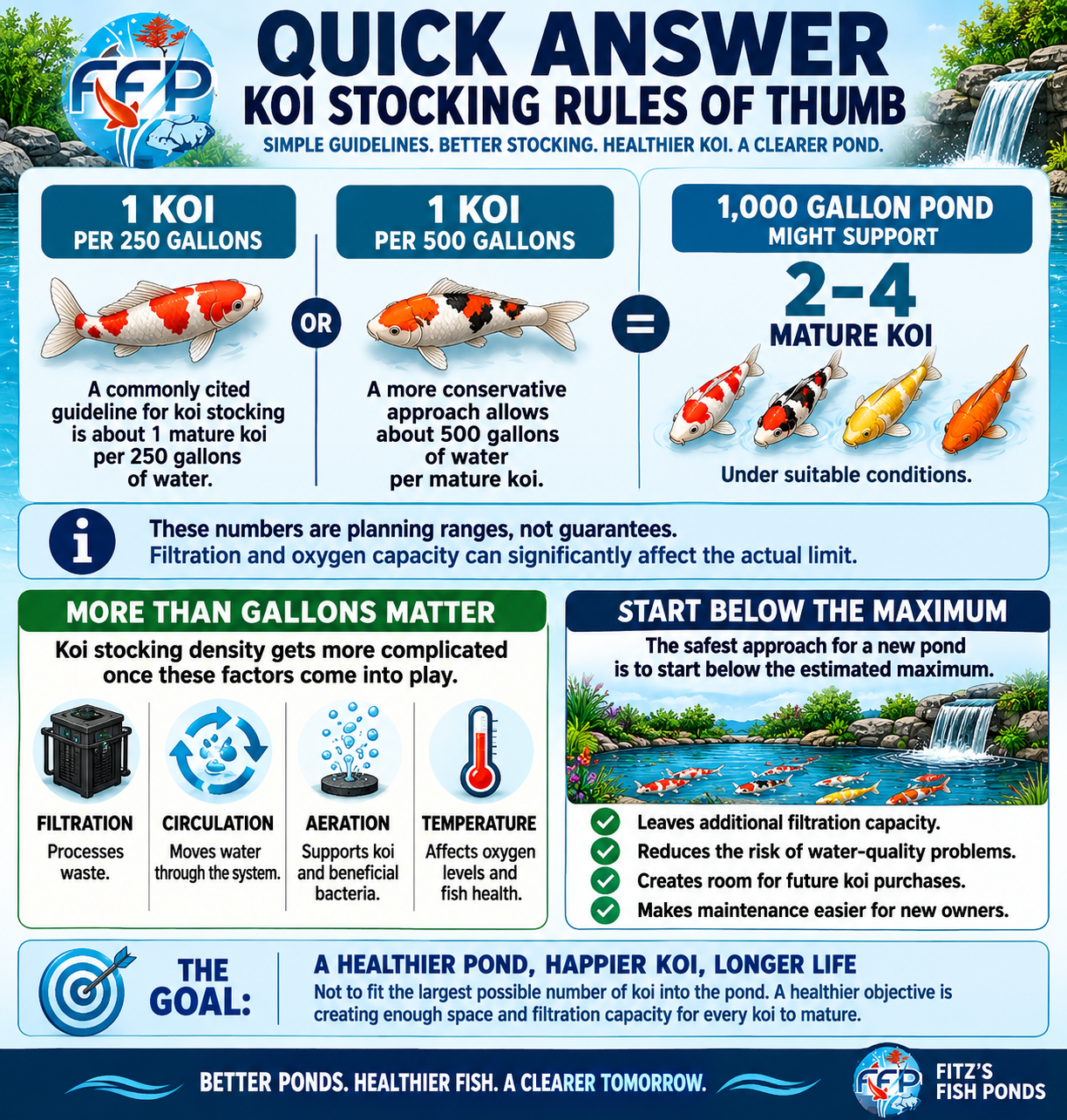
If you’re wondering how many koi a pond can hold, a conservative starting point is roughly one mature koi for every 250 to 500 gallons of water. That range isn’t an absolute rule because pond volume is only one part of the equation. Filtration, aeration, water circulation, surface area, maintenance, climate, and the eventual size of your fish can all affect how many koi a pond can safely support.
New ponds can be especially deceptive because a handful of young koi may look almost lost in all that open water. That can make it tempting to keep adding fish until the pond feels visually complete. The problem is that those smaller koi won’t stay small, and the biological load they place on the pond will increase substantially as they grow.
A safer plan is to stock below the pond’s estimated capacity and leave room for future growth. That gives the filtration system more breathing room, reduces stress on the fish, and makes water quality easier to manage. It also gives you space to add another koi later instead of realizing too late that the pond is already operating at its limit.
One commonly cited guideline is approximately 1 mature koi per 250 gallons of water, while a more conservative plan may allow about 500 gallons per fish. That means a 1,000-gallon pond might support roughly two to four mature koi under suitable conditions. Treat these numbers as planning ranges rather than guarantees, since the pond’s filtration and oxygen capacity can significantly affect the actual limit.
Koi stocking density gets more complicated once filtration, circulation, temperature, and maintenance come into play. A professionally designed pond with robust biological filtration and strong aeration may support a heavier fish load than a similarly sized pond with basic equipment. Even then, putting more koi into the same amount of water increases the burden on every part of the system.
The safest approach for a new pond is usually to start below the estimated maximum. Doing so gives the biological filter time to establish itself while leaving enough capacity for the fish already in the pond to grow.
A conservative stocking strategy offers several advantages:
The goal isn’t to fit the largest possible number of fish into the available gallons. A healthier objective is creating enough space and filtration capacity for every koi to mature without constantly pushing the pond to its biological limit.
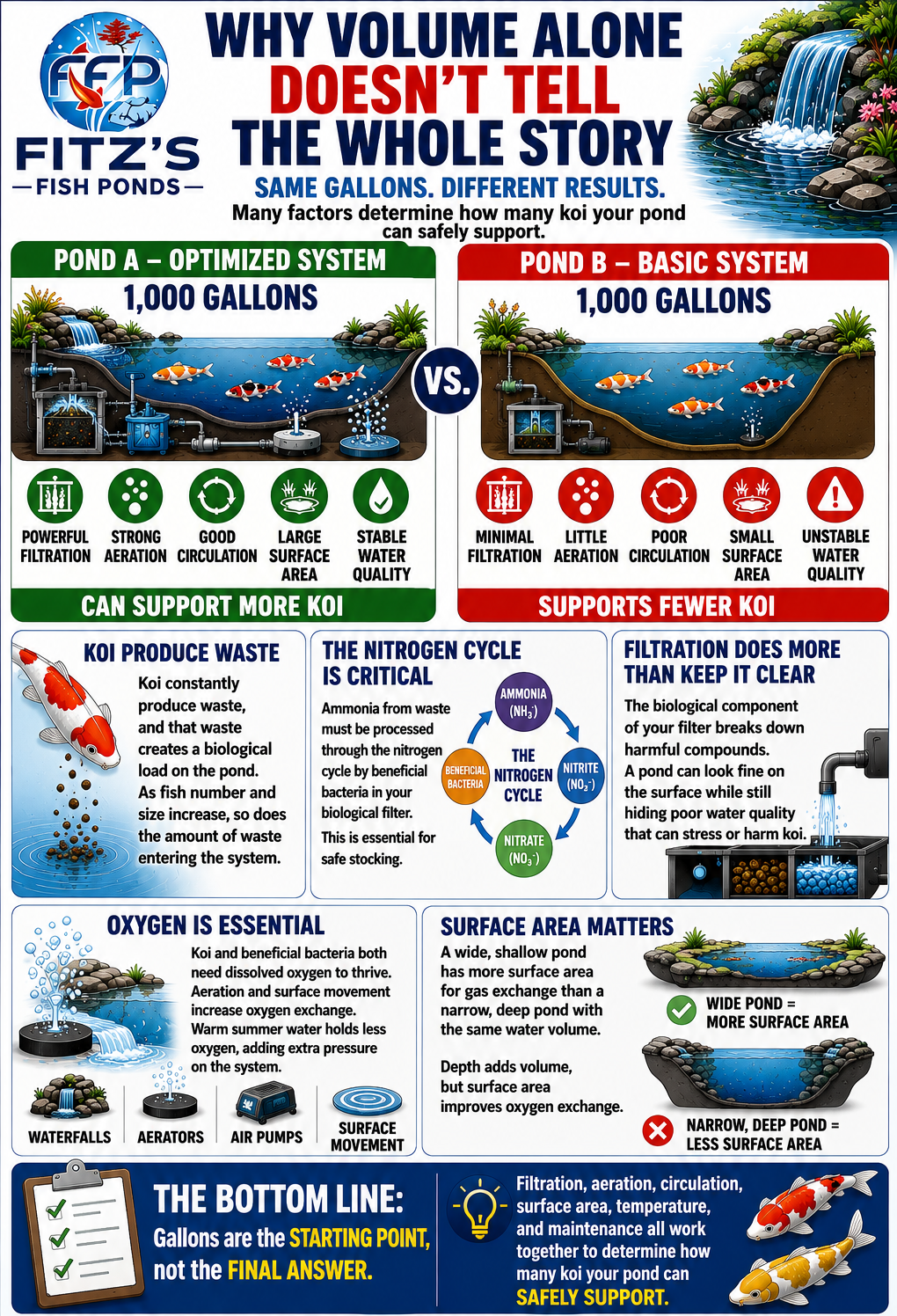
Two ponds can contain the same number of gallons and still have very different koi capacities. One may have powerful biological filtration, active aeration, strong circulation, and a large surface area. The other may have minimal filtration and little water movement, even though the total water volume is identical.
Koi constantly produce waste, which places a biological load on the pond. The system must process ammonia through the nitrogen cycle, making biological filtration central to safe stocking. As the number and size of the fish increase, the amount of waste entering the system rises.
That means the filter isn’t simply keeping the water looking clean. Its biological component helps process compounds that can become dangerous to fish when they accumulate. A pond can look visually acceptable while still experiencing water-quality problems that aren’t obvious without testing.
Oxygen is another major part of the equation. Koi need sufficient dissolved oxygen, and the beneficial bacteria in a biological filter do, too. Waterfalls, aerators, air pumps, and surface movement can all improve oxygen exchange, while warmer summer conditions can put additional pressure on the system.
Surface area deserves attention too. A broad pond offers a different opportunity for gas exchange than a narrow, deep pond with the same water volume. Depth is valuable, but gallons alone don’t describe every condition affecting the fish.
That is why a gallon figure should be the starting point for a stocking calculation, not the final answer.
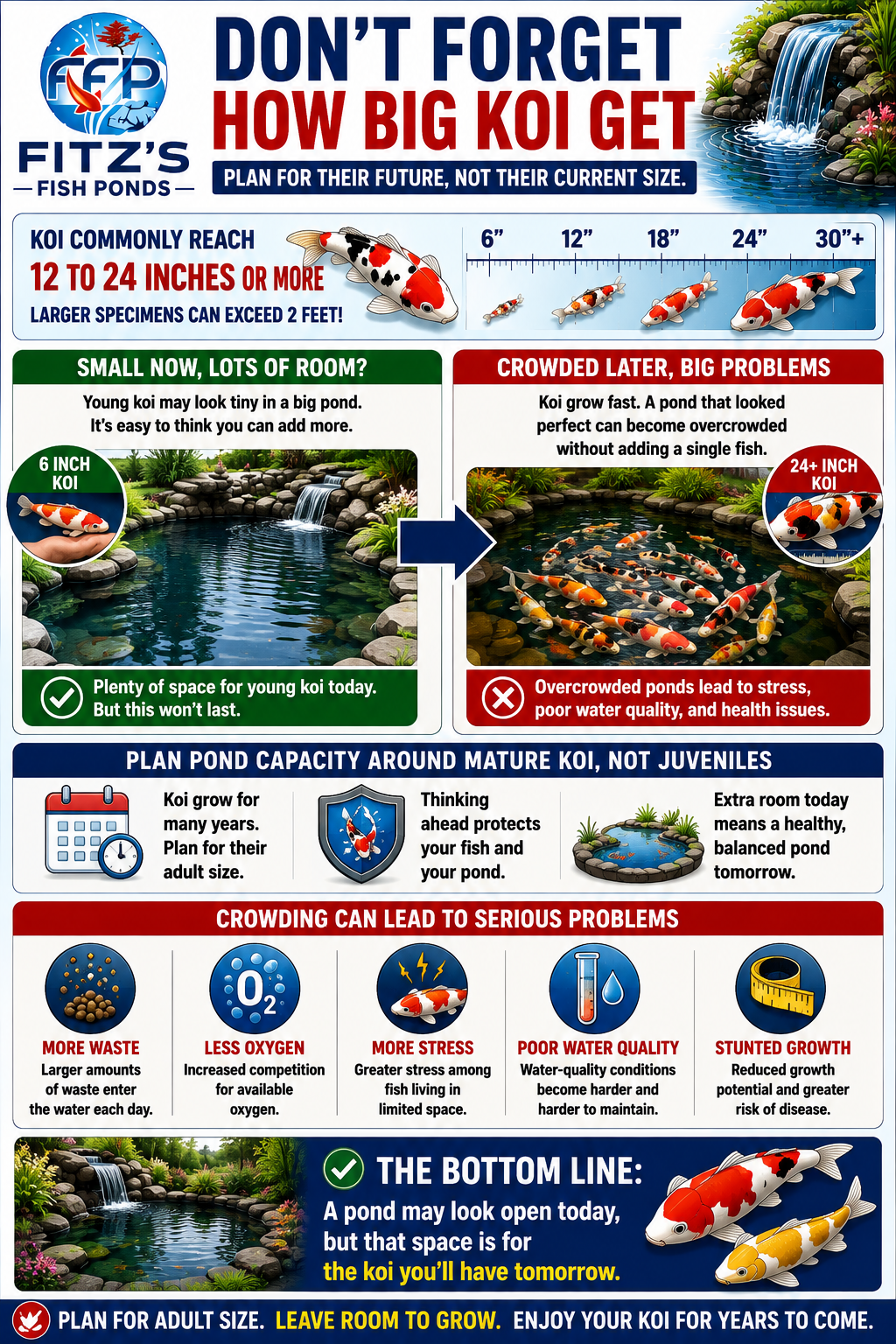
A six-inch koi can make even a modest pond look enormous. Give that fish enough time, proper care, and suitable conditions, and the picture can change dramatically. Koi commonly reach approximately 12 to 24 inches or more, and larger specimens can exceed two feet.
Stocking a pond based on the size of young fish is one of the easiest ways to create problems later. Several juvenile koi may have plenty of room during their first season, but their waste production and space requirements increase as they mature. A pond that initially looked lightly stocked can eventually become crowded without adding a single fish.
That’s why pond capacity should be planned around mature koi rather than the fish you see at the time of purchase. Thinking ahead gives the fish room to grow and reduces the likelihood that filtration will become inadequate several years later.
Crowding can contribute to several issues:
Planning around adult size may leave a new pond looking somewhat open at first. That extra room is intentional. The pond will look very different once its residents have had time to mature.
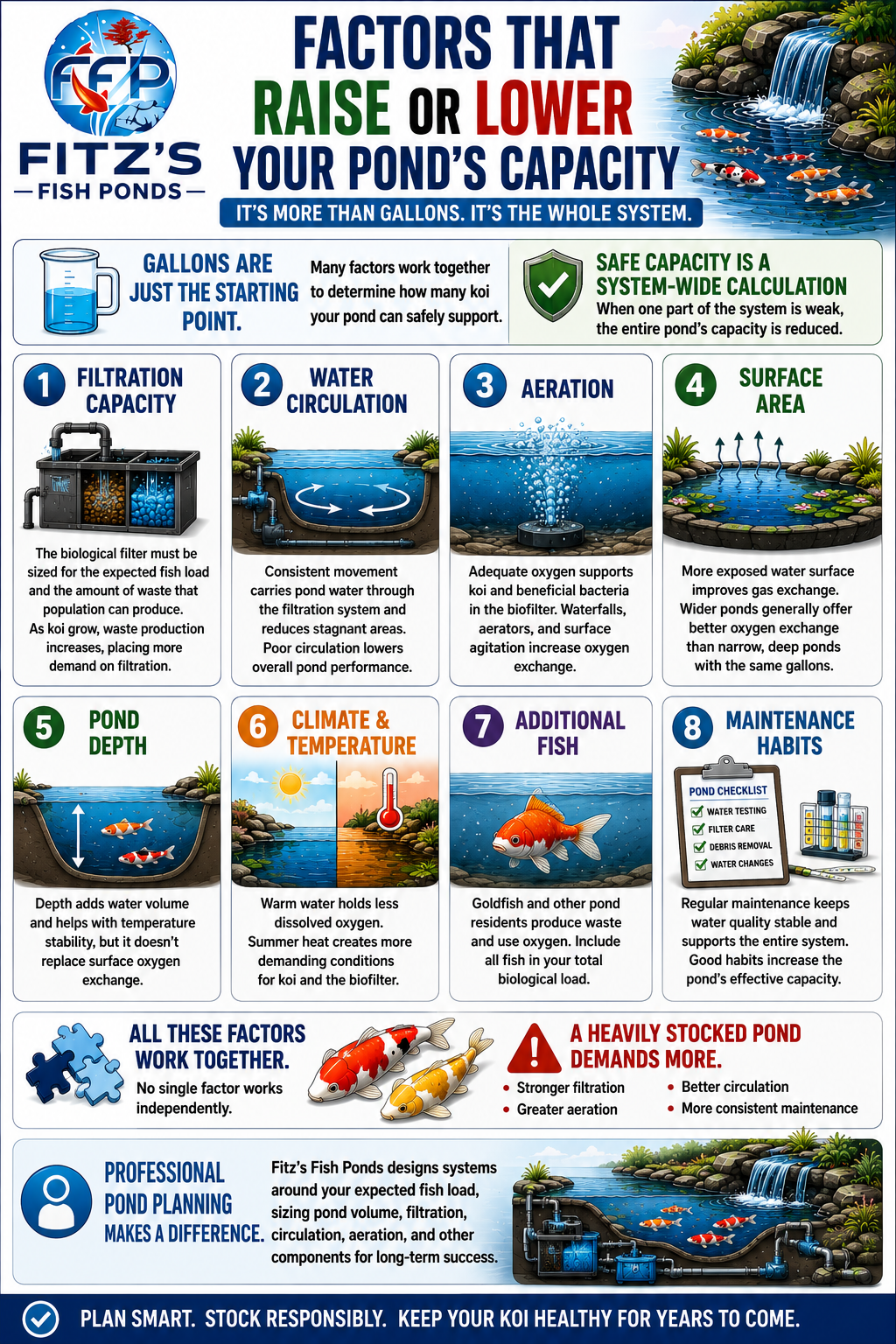
Safe koi capacity is really a system-wide calculation. Gallons provide a useful baseline, but several other factors determine how comfortably a pond can support its fish population.
Filtration capacity is one of the most important. Biological filters need enough capacity to process waste from the entire fish load, not just the fish originally introduced to the pond. As koi grow, the filtration system must handle the increased biological demand.
Water turnover also plays a role. Pond water needs to circulate through the filtration system regularly enough to support consistent water quality. A large pond with poor circulation may not perform as well as its gallon count would suggest.
Aeration affects both the koi and the biological processes occurring in the pond. Waterfalls, dedicated aerators, and other forms of surface agitation can increase oxygen exchange. Hot weather deserves extra attention because warmer water generally contains less dissolved oxygen than cooler water.
Several variables should be considered together:
No single factor works independently. A heavily stocked pond usually demands stronger filtration, greater aeration, and more disciplined maintenance than a lightly stocked one.
This is also where professional pond planning can help. Fitz’s Fish Ponds can account for expected fish load while sizing pond volume, filtration, circulation, and other system components around the number and type of fish the pond is intended to support.
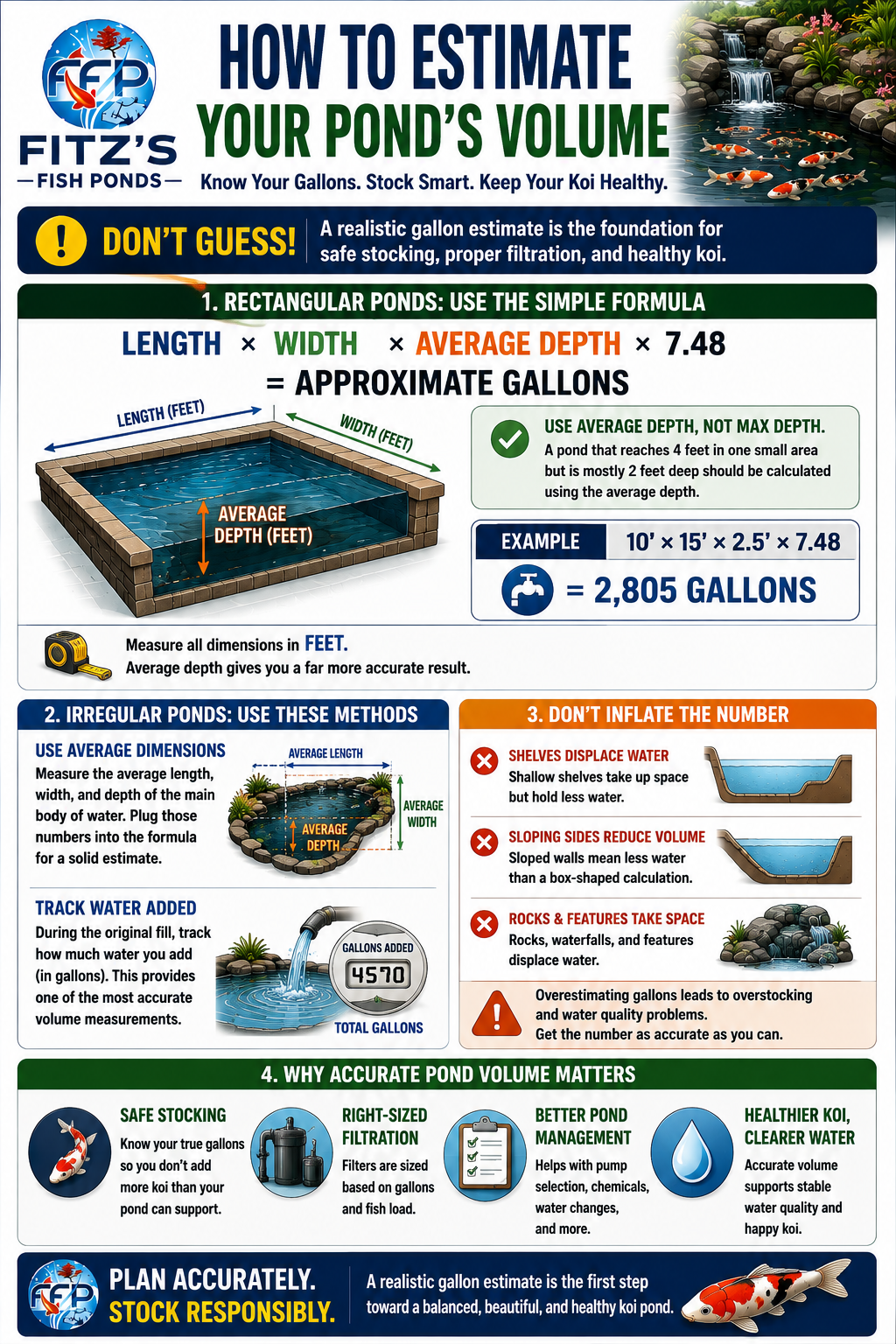
Before deciding how many koi to add, you need a realistic estimate of how much water the pond actually contains. Guessing based on appearance can be misleading, especially if the pond includes shelves, curves, sloping walls, rockwork, or large depth variations.
For a basic rectangular pond, a common volume calculation is:
Length × Width × Average Depth × 7.48 = Approximate Gallons
Take measurements in feet, and average depth is usually more useful than measuring only the deepest point. A pond that reaches four feet in one small area but spends most of its footprint at two feet shouldn’t be calculated as though the entire pond were four feet deep.
Irregular ponds require a little more estimation. You can use average dimensions for a practical approximation, and tracking the water added during the original fill can offer an even clearer picture when that information is available.
Be careful not to inflate the calculation. Shelves and sloping sides can reduce the actual water volume compared with a simple length-width-maximum-depth calculation.
Accurate pond volume matters for several reasons beyond stocking. It can also affect filtration planning and other aspects of pond management. Starting with an exaggerated gallon figure can make the pond appear capable of supporting more fish than it realistically should.
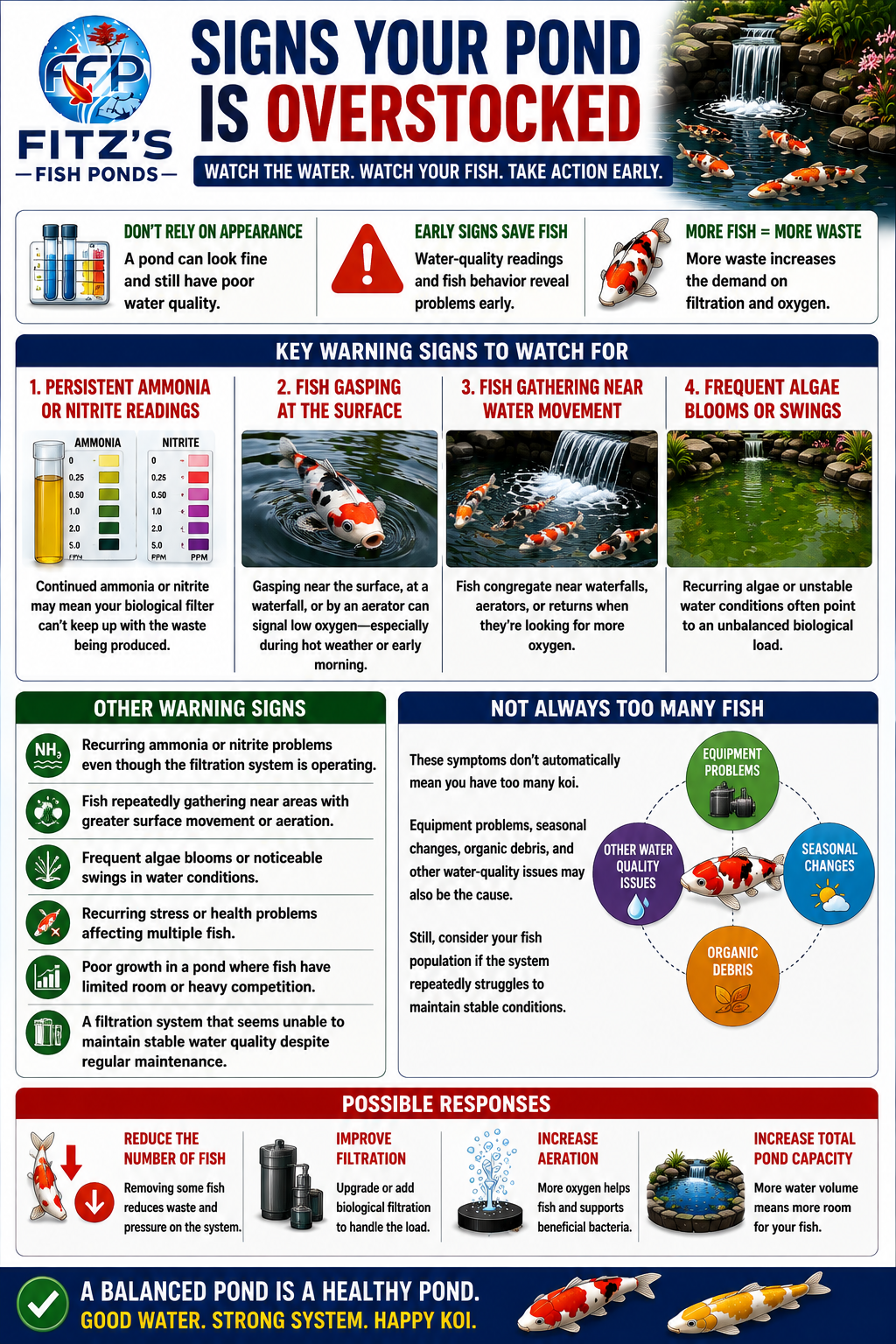
A pond doesn’t need to look packed with fish to be biologically overloaded. Water-quality readings and fish behavior can reveal problems long before the pond looks crowded.
Persistent ammonia or nitrite readings deserve particular attention. These readings may indicate that the biological filtration system is struggling to keep up with the waste being produced. Investigate the cause rather than assuming the filter is functioning properly just because water is circulating.
Fish gasping near the surface, at a waterfall, or by an aerator can also signal trouble, particularly during hot weather or early morning periods when oxygen conditions may be less favorable. Low oxygen levels can have several causes, but a heavy fish load increases the pond's total oxygen demand.
Other warning signs may include:
These symptoms don’t automatically prove that too many koi are present. Equipment problems, seasonal changes, organic debris, and other water-quality issues may also contribute. Still, consider the fish population if the system repeatedly struggles to maintain stable conditions.
Possible responses include reducing the number of fish, improving filtration, increasing aeration, or increasing total pond capacity. The right choice depends on which part of the system is limiting performance.
A conservative guideline of roughly one mature koi per 250 to 500 gallons gives new pond owners a practical starting point. The real stocking limit depends on much more than pond volume, so don't treat that figure as an automatic guarantee.
Plan around mature fish, not juveniles. Give equal attention to biological filtration, circulation, aeration, surface area, climate, and the maintenance routine required to support the population.
Starting with fewer fish is usually easier than trying to correct an overloaded pond later. It leaves room for koi to grow, gives the biological filter time to mature, and provides flexibility if you want to add another fish in the future.
A pond designed around the expected adult fish population can also make long-term management far more practical. The goal is a pond that comfortably supports its koi rather than one operating at its maximum possible capacity every day.
A healthy koi pond takes more than the right number of fish. Fitz’s Fish Ponds offers professional pond cleaning, routine maintenance, water testing, seasonal care, winterization, equipment repairs, service consultations, and ongoing pond support designed to keep water quality stable and koi in strong condition.
Whether you’re dealing with algae, filtration issues, seasonal changes, or simply want experienced eyes on your pond, the FFP team can evaluate your system and recommend the right level of care for your setup. Learn more about our pond maintenance services. Got questions? Talk to an expert online or call us at (908) 420-9908.
How Many Koi Can I Put In A 1,000 Gallon Pond?
A conservative guideline would place a 1,000-gallon pond at roughly two to four mature koi. The lower end provides considerably more room for growth and reduces pressure on filtration and oxygen levels. Filtration quality, aeration, pond shape, climate, and maintenance can all change the realistic number. Treat the range as a starting point, not a guaranteed stocking limit.
How Many Gallons Does One Koi Need?
A commonly cited planning figure is around 250 gallons per mature koi, with more conservative stocking allowing closer to 500 gallons per fish. More water gives the fish more space and reduces waste concentration in the system. Strong filtration and aeration remain important regardless of the gallon figure. Adult size should always be part of the calculation.
Can You Have Too Many Koi In A Pond?
Yes, a koi pond can become overstocked even if the fish still appear to have enough physical swimming room. Too many fish increase waste production, oxygen demand, and pressure on biological filtration. Over time, those conditions may contribute to unstable water quality, stress, poor growth, and recurring health issues. Maintaining extra capacity is generally safer than trying to keep the pond at its maximum possible fish load.
How Big Do Koi Get In A Pond?
Koi commonly reach approximately 12 to 24 inches or more under suitable conditions. Some larger koi can exceed two feet, which is one reason juveniles can be misleading during initial stocking. A group of small koi may look sparse during the first year and considerably more crowded after several seasons of growth. Pond planning should account for mature fish rather than their purchase size.
How Many Koi Can A 1,500 Gallon Pond Hold?
Using the conservative range discussed in this guide, a 1,500-gallon pond may support roughly three to six mature koi. Three fish would provide substantially more room per koi than six fish and would place a lighter load on the filtration system. The pond’s actual capacity still depends on filtration, aeration, circulation, temperature, fish size, and maintenance. A gallon calculation alone shouldn’t be used as permission to add fish.
Does Filtration Affect How Many Koi I Can Keep?
Yes, filtration is one of the biggest factors affecting koi pond capacity. Biological filtration processes waste produced within the pond, so increasing the fish population also increases the filter's workload. A system that performs well with three small koi may struggle after those same fish become much larger. Filtration should be planned around the expected adult fish load rather than the pond’s initial population alone.
What Happens If A Koi Pond Is Overstocked?
An overstocked pond can have higher ammonia and nitrite levels, lower available oxygen, unstable water conditions, and greater stress on the fish. The filtration system may struggle to process the amount of waste entering the water each day. Fish may gather near waterfalls or aeration equipment if oxygen becomes limited, and recurring health problems can become more common. Reducing fish load or increasing system capacity may be necessary if the pond repeatedly struggles.
How Many Koi Should I Start With In A New Pond?
Start below the pond’s projected maximum instead of filling it to capacity immediately. New biological filtration needs time to establish, while young koi keep producing more waste as they grow. A smaller starting population gives you a chance to monitor water quality and see how the pond performs under real conditions. It also leaves room for future additions without forcing the system beyond a comfortable fish load.
| Hours | |
|---|---|
| sunday | 10:00 AM - 4:00 PM |
| monday | Closed |
| tuesday | 10:00 AM - 5:00 PM |
| wednesday | 10:00 AM - 5:00 PM |
| thursday | 10:00 AM - 5:00 PM |
| friday | 10:00 AM - 5:00 PM |
| saturday | 10:00 AM - 5:00 PM |
| Hours | |
|---|---|
| sunday | 10:00 AM - 5:00 PM |
| monday | Closed |
| tuesday | 11:00 AM - 6:00 PM |
| wednesday | 11:00 AM - 6:00 PM |
| thursday | 11:00 AM - 6:00 PM |
| friday | 11:00 AM - 6:00 PM |
| saturday | 10:00 AM - 5:00 PM |
| Hours | |
|---|---|
| sunday | 10:00 AM - 4:00 PM |
| monday | Closed |
| tuesday | 10:00 AM - 5:00 PM |
| wednesday | 10:00 AM - 5:00 PM |
| thursday | 10:00 AM - 5:00 PM |
| friday | 10:00 AM - 5:00 PM |
| saturday | 10:00 AM - 5:00 PM |
| Hours | |
|---|---|
| sunday | 10:00 AM - 5:00 PM |
| monday | Closed |
| tuesday | 11:00 AM - 6:00 PM |
| wednesday | 11:00 AM - 6:00 PM |
| thursday | 11:00 AM - 6:00 PM |
| friday | 11:00 AM - 6:00 PM |
| saturday | 10:00 AM - 5:00 PM |
| Hours | |
|---|---|
| sunday | Closed |
| monday | 10:00 AM - 4:00 PM |
| tuesday | 10:00 AM - 4:00 PM |
| wednesday | 10:00 AM - 4:00 PM |
| thursday | 10:00 AM - 4:00 PM |
| friday | 10:00 AM - 4:00 PM |
| saturday | Closed |
| Hours | |
|---|---|
| sunday | 10:00 AM - 4:00 PM |
| monday | Closed |
| tuesday | 10:00 AM - 5:00 PM |
| wednesday | 10:00 AM - 5:00 PM |
| thursday | 10:00 AM - 5:00 PM |
| friday | 10:00 AM - 5:00 PM |
| saturday | 10:00 AM - 5:00 PM |
| Hours | |
|---|---|
| sunday | Closed |
| monday | Closed |
| tuesday | 10:00 AM - 5:00 PM |
| wednesday | 10:00 AM - 5:00 PM |
| thursday | 10:00 AM - 5:00 PM |
| friday | 10:00 AM - 5:00 PM |
| saturday | 10:00 AM - 5:00 PM |
| Hours | |
|---|---|
| Sunday | Closed |
| Monday | Closed |
| Tuesday | 10:00 AM - 5:00 PM |
| Wednesday | 10:00 AM - 5:00 PM |
| Thursday | 10:00 AM - 5:00 PM |
| Friday | 10:00 AM - 5:00 PM |
| Saturday | 10:00 AM - 5:00 PM |
| Hours | |
|---|---|
| Sunday | 10:00 AM - 4:00 PM |
| Monday | Closed |
| Tuesday | 10:00 AM - 5:00 PM |
| Wednesday | 10:00 AM - 5:00 PM |
| Thursday | 10:00 AM - 5:00 PM |
| Friday | 10:00 AM - 5:00 PM |
| Saturday | 10:00 AM - 5:00 PM |